Someone Already Solved the AI Problem You're Stuck On

We open-sourced the Pluris AI Use Case Library: hundreds of real implementations from the best AI builders in the world. See how your problem got solved, what it cost, and who did the work
Start smaller than you think
Of the AI projects in our library that disclose a budget, about six in ten came in under $100,000. Of the ones that disclose a timeline, more than half were live in under two months. Those numbers come from real implementations written up by the specialists who built them, and they look nothing like what most leadership teams expect to spend.
The prevailing advice runs top down. Hire a chief AI officer, stand up a data platform, sign a seven-figure transformation program, and eventually orchestrate dozens of agents across the enterprise. It sounds rigorous, and it's how plenty of companies end up a year in with a lot of activity, no problems solved, and no ROI to show for it.
The companies in the library mostly started somewhere smaller. They picked one problem that cost them real hours or real revenue, found someone who had solved something like it before, and shipped a fix in weeks before going after the next one.
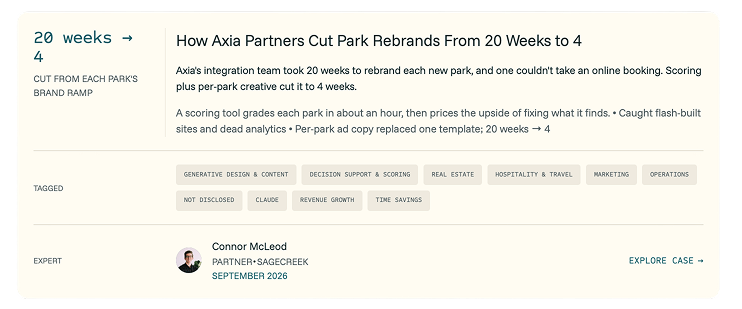
Jake Jones at Axia Partners had just spent 80 hours building a comparable-properties analysis by hand. He ran a new AI agent as a check. In a day, it found every comp he had found, plus about twice as many he'd missed. Axia's full portfolio refresh used to take three weeks. It now runs overnight for about $200 a month.
Most companies never get to that moment. A private equity partner told me his firm had a stack of AI tools nobody used and a pile of consulting proposals nobody inside was equipped to judge. There was no CIO and no CTO, just investment professionals making decisions on half the information they needed, worried that anything they spent six figures on today would be obsolete in a year.
He isn't unusual, and the cost of waiting is, imho, more than you know. Get the first move right and you build an edge that compounds and gets harder for competitors to close. Get it wrong and you lose the next six months, along with stakeholder enthusiasm and organizational momentum, while everyone else pulls ahead. Momentum is oxygen, and when an initiative is new and unproven, early disappointment is what suffocates it.
Getting it right is hard, for reasons you probably recognize.
- You don't know where to start or what this technology can really do. It's hard to picture what's possible until you've seen someone else pull it off.
- You don't have the talent in-house to build it well.
- Your existing partners aren't built for this. They're too expensive, too slow, and often no more experienced than you are.
- You can't tell the good firms from the ones that just market well.
- Nobody can tell you what the work should cost, so every quote is a number you can't check.
Move the proof to the front
Every one of those problems comes down to the same gap: you're asked to decide before you've seen evidence. Software companies have used case studies for decades, and they put them at the end of the sale. The case study shows up once a buyer is mostly decided, as reassurance that companies they recognize made the same call and came out fine. AI buyers need that evidence at the very start, while they're still working out what's possible, who's credible and where to begin. The case study has to move from the close to day one, which is the argument I made at length in Proof of Work: Who to Trust With Your AI.
We built the Pluris AI Use Case Library to fill that gap. Start with a problem and it shows you where others started and what they built. Every case names the expert and firm behind the result, and most give you a benchmark for what comparable work cost. Each case covers the problem, the approach, the cost, the timeline and the result, and the whole thing is free.
We made it free because the evidence only works if everyone can see it. The best AI builders are rarely the loudest. Many run thirty-person firms nobody has heard of, doing cutting-edge work without the marketing budget of the big consultancies. When they show their work, the difference is obvious. The library gives them a place to show it, and it lets every buyer find them on the strength of what they've built.
What the cases tell you
First projects cost less than most people expect. Among cases that disclose a budget, about six in ten came in under $100,000 and eight in ten under $250,000. Only about one in five cases discloses cost at all, so on its own this is a directional benchmark. What I see on the other side of the table backs it up. For nine months we've put client problems in front of our network, and the proposals that come back have consistently landed below what the client expected to spend. Keep that in mind the next time someone hands you a seven-figure proposal for a first project.
They move faster, too. Among cases that disclose a timeline, more than half went live in under two months, and about three in four within four months.
The ones that worked fixed the boring stuff first. Case after case, the team sorted out its data or its process before building anything. A manufacturer's finance team interviewed staff on why each line in its chart of accounts existed before touching the data. A professional services firm ran a four-week feasibility study that proved 98% accuracy before anyone funded the build. Zapier made its pipeline measurable before trying to improve it, and cut hallucinated endpoint paths from 26% to under 1%.
What's in it
The Pluris AI Use Case Library catalogs hundreds of cases, all real AI implementations, by industry, business function, company size, ownership, type of AI, source of value, project cost and time to results, along with the model each one runs on. You can go straight to PE-backed manufacturers using document processing to cut costs, or to founder-owned services firms using AI to grow revenue. Most people start with the outcome they're after.
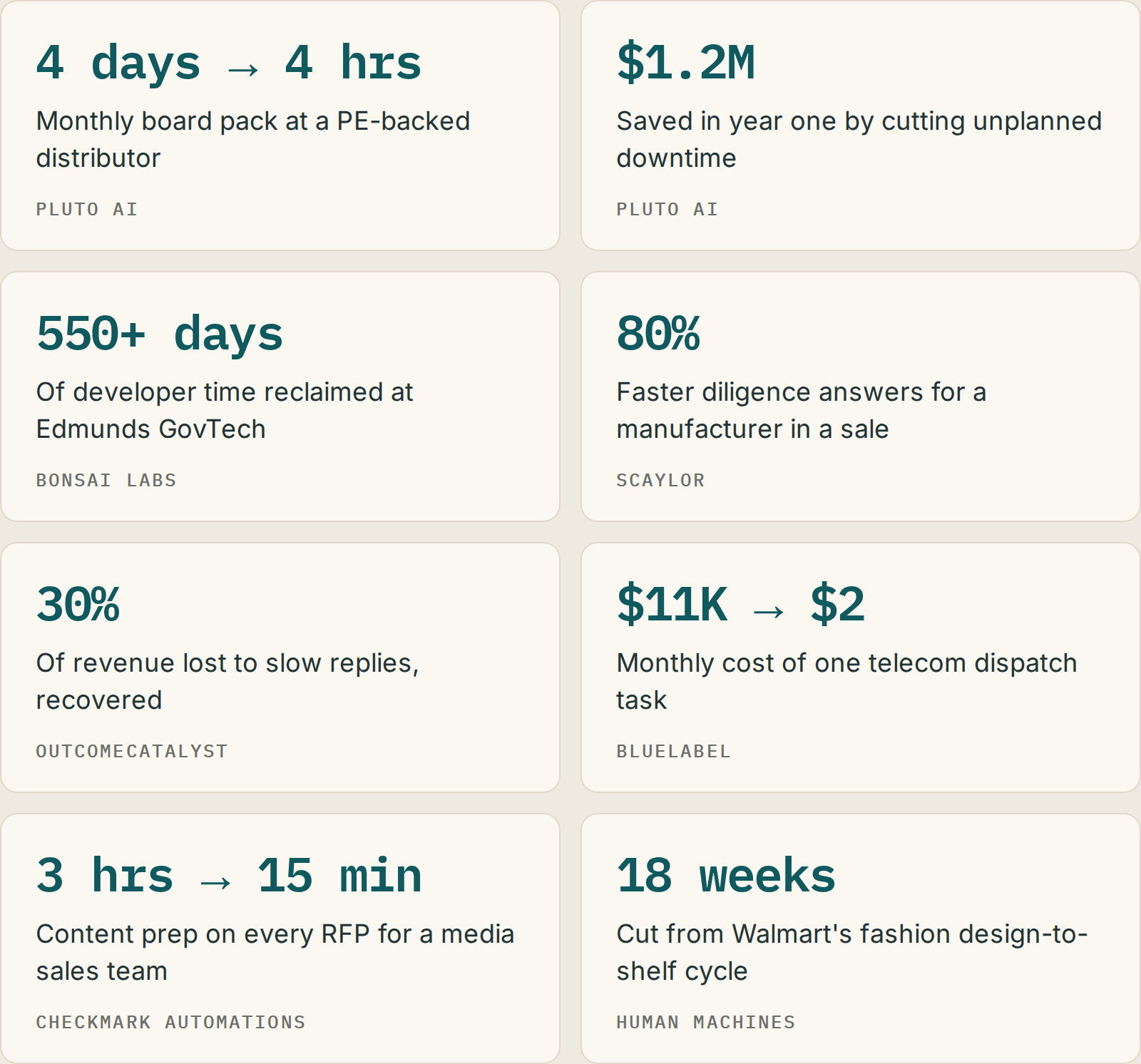
If you're chasing revenue growth, there are more than 80 cases to work from. A founder-owned industrial manufacturer recovered about 30% of the revenue it was losing to slow replies, on a project under $25,000. A finance-copilot vendor took net revenue retention from 82% to 144% once its product was reliable enough for customers to trust. A 500-store retailer recovered $15 million in annual stockout and fulfillment losses tied to phantom inventory.
If you're focused on margin, nearly 80 cases target cost. A fiber ISP moved a dispatch task costing $11,000 a month in salary onto an AI agent that runs on about $2 a month in tokens. A PE-backed healthcare software company consolidated more than 290 single-customer installations into one platform and removed an estimated $500,000 a year in licensing fees.
If you're a PE firm, around 50 cases cover both sides of the job: making the firm itself AI-native and creating value in the portfolio. A $40 billion PE firm took daily AI use from 5% of its people to more than half. A solo independent sponsor runs 93 deals and 402 companies through his pipeline with no analysts. On the portfolio side, one fund rolled a single predictive-maintenance build across three factories and saved $2.7 million a year, with the third rollout taking half as long as the first.
Find your first AI project in an afternoon
We designed the library to do three things: show you what's possible, get you moving on something specific, and put you in touch with the people who built it. Here's how to use it to go from a vague sense that AI should help to a first project you can defend in a budget meeting, in about an afternoon.
1. List the work that eats the most hours. Pick three tasks your team repeats every week or month, where someone could check whether the output is right. Board packs, quote turnaround, month-end reconciliation, inbound lead response and first-pass document review are common starting points.
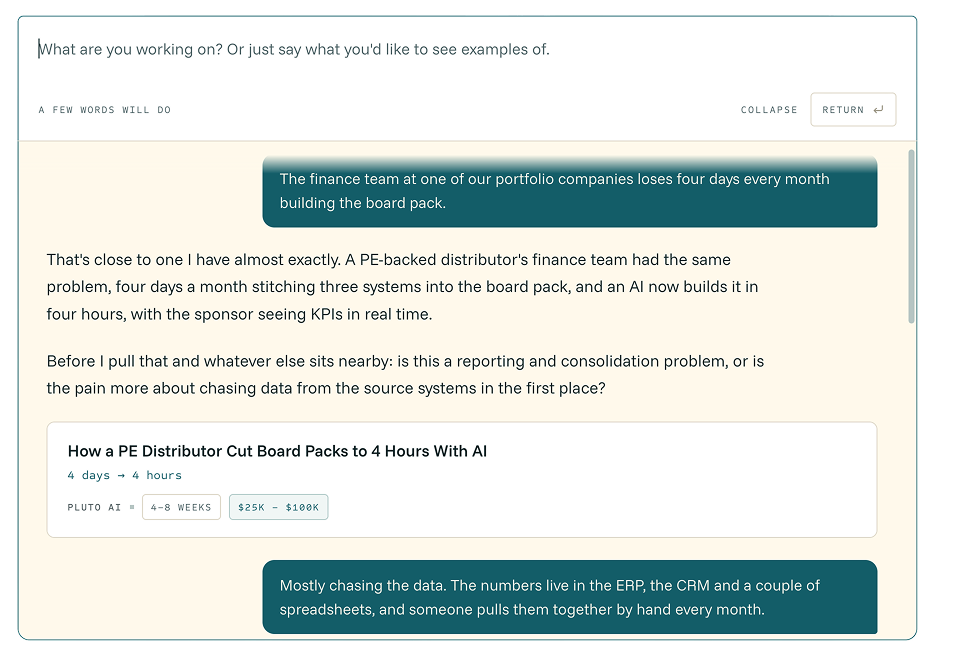
2. Ask the library about each one, in your own words. Say you're an operating partner, and the finance team at one of your portfolio companies loses four days every month building the board pack. Type that in. The library comes back with a PE-backed distributor whose finance team had the same problem and now builds its board pack in four hours, with the sponsor seeing KPIs in real time. The case tells you it was a $25,000 to $100,000 project, live in four to eight weeks, and names Pluto AI as the firm that built it. Then it asks you a question back, the way a good advisor would: is the pain in consolidating the reports, or in chasing the data out of the source systems in the first place? Your answer decides which cases it pulls next.
A few questions to start with, depending on your seat:
- Operating partner: "We want AI across the portfolio, but every company is starting from scratch."
- CFO: "Month-end close takes two weeks because we reconcile entities in spreadsheets."
- Head of sales: "We lose inbound deals because we take too long to respond."
- Sales or estimating lead: "Custom quotes take us days, and we keep losing jobs to whoever answers first."
- CMO: "We keep raising ad spend and can't tell which channels actually bring in customers."
- COO: "We have sensor data on our lines, but unplanned downtime keeps surprising us."
- Deal team: "Every CIM takes an associate a full day to triage."
- Chief of staff: "Leadership wants an AI plan, and I'm the one who has to write it."
- Business owner: "My team spends half the day answering the same customer questions."
3. Check whether you look like the company in the case. Every case describes the kind of company it suits and what had to be in place before the build: the data, the systems, the people. Read that section for the two or three closest matches. If your situation lines up, you have a strong first project. If it doesn't, you know what to fix first, whether that's cleaning up the data, documenting the process, or finding the person who will own it.
Then talk to the people who did the work. Every case has a button to connect with the firm behind it. We make the introduction, and you can ask them directly whether your situation is a fit. If you'd rather not start with a single firm, describe your need once and we'll share it, without your name attached, with the specialists whose work matches it. You'll hear how each of them would approach it, and it costs you nothing.
4. Hold every quote up to the benchmarks. Compare any proposal against the cost and timeline ranges on comparable cases. If a first project is priced at five times what similar work ran elsewhere, ask why.
5. Ask every firm for the comparable case. When anyone pitches you, ask to see a case like the one you found, with the cost and the result. It's the fastest way to separate the firms that have done this work from the ones hoping to learn it on your project.
Where first projects go wrong
The cases show what worked. Meeting hundreds of the firms behind them, and working through client briefs every week, has shown me where first projects tend to stall. It usually has more to do with how the project was set up than with the technology.
- Starting with a tool instead of a problem. Licenses get bought, a pilot gets launched, and six months later nobody can say what it was meant to fix. The PE firm I mentioned at the top had a stack of AI tools nobody used. Start with the task that eats the hours and work back to the tool.
- Nobody on the business side owns it. One founder I spoke with had run three pilots and shipped none of them, with no way to tell whether the problem was the technology, the vendor or the plan. Name the person whose numbers depend on the project before anyone writes a line of code.
- Building before the ground is ready. If the data is scattered or the process lives in one person's head, the build stalls. A short feasibility pilot is cheap insurance, and several cases in the library started with four to six weeks of proving the idea before the real money went in.
- Assuming people will use it. A system nobody adopts is a failed project with a nice demo. The cases that stuck planned for adoption from the start. Walmart's designers helped build the system that now runs their workflow, and a $40 billion PE firm took daily AI use from 5% of its people to more than half by treating rollout as a project of its own.
Where this is going
Hundreds of cases is a start. Over the next year we want more than 1,000, with enough coverage across industries, functions and company sizes that almost anyone can find a close match for the problem in front of them.
The most valuable use we've found for the library so far goes beyond a single search. Map it against a specific company, or across a whole portfolio, and it surfaces the opportunities that fit each business, along with the cases that prove them and the firms that have done the work. It doesn't replace a proper diagnostic, but it gets you to a credible starting list far faster than a blank whiteboard does. Pluris clients have these maps in their portals, ready to act on.
The longer-term payoff is in the data. Every case adds a record of what this work actually cost, how long it took and what it returned. Across a thousand implementations, that becomes something the market has never had: a benchmark for AI decisions built on work that was really done, one that tells you which problems are worth solving first and what a fair price looks like before anyone sends a proposal.
You don't need to wait for a thousand cases, though. The one that matches your problem may already be there. Start with the problem you're stuck on, before the budget meeting and before the next vendor pitch lands on your desk, and ask the library about it.
If you build AI, show your work
If you run an AI implementation firm, your best sales asset is probably sitting in a folder somewhere: the project that moved a number for a client. Put it where buyers are looking. A case in the library is a credential earned in production rather than asserted on a slide, and it reaches buyers while they're still working out what to do, well before any vendor gets a meeting.
The detail is what makes it work. Say what it cost, how long it took, what produced the return and the conditions that would have sunk it. That's what lets a stranger trust a firm they've never heard of, and it's how hiring in this market starts to follow the evidence instead of the size of the logo.
Submitting a case is free. Every published case credits the expert and firm behind it and carries a button that connects buyers straight to you. You're also how we get to 1,000. Share your work with us here.
I'm Stu Willson, founder of Pluris. Over the past 18 months I've met with more than 400 AI implementation firms, which is where this library comes from.

A vetted network of independent AI teams who’ve done the work. Helping PE and enterprise leaders see what’s worth doing, what it should cost, and who’s proven they can build it.